Prayerfully Support The Mission

Thursday, May 9, 2019

The Practice of Footwashing in the Bible


1.   
     
Footwashing was standard practice for first century culture in light of the dry climate. Since most people traveled by foot, wore sandals, and eating necessitated close proximity to each other, the standard practice was to wash the guests’ feet as they entered the house. “To wash the feet of one’s guests was common hospitality, the breach of which was a serious affront” (Lk. 7:44)[1]  The task of washing feet was usually reserved for a servant. It was considered such a debasing act that even (some) “Jews insisted that Jewish slaves should not be required to was the feet of others; this job should be reserved for Gentile slaves, or for women and children and pupils.”[2]

Tuesday, May 7, 2019

Did John Calvin Miss The Mark? - Treating Our Neighbors

I came across this piece of his-story...John's that is. Did he feel pressured to respond in light of his role/responsibility? I am conducting a study on the adulterous woman (Jn. 8:1-11) and discovered that this pericope has shaped much of Christianity's position on marriage and the family (amidst the contention on its placement in the Johannine text):

Alleged adultery made John Calvin persecute vigorously Anne le Fret, his sister-in-law, who looked after their common household. Although he could procure no decisive proof of her guilt, he managed to arrange a divorce with the right o f remarriage (against the Roman tradition), and removed her from the house with loss o f her children. She was spared capital punishment, as she kept denying, despite seven rounds o f torture. Although Calvin’s first attempt in 1548 had failed, and his brother Antoine was forced to reconcile with Anne, the text o f Jn. 8:1-11 has apparently meant little to the case, which w as treated by these reformers as a clearcut ecclesiastical affair.

See Kingdom, R. Adultery and Divorce in Calvin 's Geneva, Cambridge Mass. Harvard U .P. 1995 p .71-98.

Wednesday, April 24, 2019

Hermeneutics Questions & Answers


                                        The Discipline of Hermeneutics

Regarding  Bible Translations

Define the terms “formally equivalent” and “functionally equivalent” with regard to translation theories.
Formal equivalent refers to a literary translation of the Greek and Hebrew text into English syntax.  This process “prioritizes preserving the form and structure of the text over what is the most intelligible English.”[1] By seeking to remain as close as possible to the original form of the Greek and Hebrew language, the form equivalent “may appear awkward, less sensitive to a contemporary audience, and may sacrifice meaning for form.”[2] In contrast, the functionally equivalent renders more of a dynamic interpretation of the Greek and Hebrew language into English. This rendering seeks to “reflect better English,” placing the “priority on clarity over grammar and syntax.” Another way to define the functional is that it brings the text closer to the language of the contemporary reader (an attempt to reproduce the same effects as experienced by the original audience).[3]

Saturday, April 6, 2019

The Book of John: Authorship, Purpose & Provenance


Internal & External Evidence of Johannine Authorship 
It is important to establish John as the author of the Gospel bearing his name primarily for apostolic eyewitness and authorship. This especially during a period of Gnostic influences. Köstenberger aptly puts it this way: “John’s Gospel claims to represent apostolic eyewitness testimony regarding Jesus’ earthly ministry.”[1]  There is ample internal and external evidence in support of Johannine authorship with John being “John, the son of Zebedee,”  one of Jesus’ disciples. The internal evidence is as follows:
·         The author is identified in Jn. 13:23 as “the disciple whom Jesus loved.” That he is “the disciple whom Jesus loved” is also mentioned in 21:2, 23, and stated as the “one who “testified to these things and wrote them down” (21:24). The author also has close connections to Peter and part of Jesus’ inner circle (Lk. 5:8-10,8:51; Mk. 3:16-17, 5:37; Mat. 17:1-2). Of noteworthy mention is the visit to Jesus’ tomb on Resurrection Sunday, where the author is identified as “the one whom Jesus loved” (20:1-8).

Sunday, March 31, 2019

The Definition of Hermeneutics


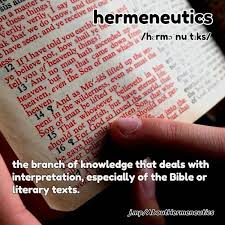
During a recent fallout over a church split and the subsequent ousting of the senior pastor, the church community was up in arms over the influence of Calvinism. The senior pastor was accused of abandoning the faith (Oneness). An elder in making the case against him cited ‘Sola Scriptura’ and began to use the proof-texting method to denounce the pastor’s actions. A more thorough investigation of the claims revealed a lack of applying proper hermeneutics, which could have prevented the fallout. Hermeneutics involves ‘the task of explaining, interpreting, and translating the Scriptures.”[1] Outside of the objective text, hermeneutics pulls back the curtain, and reveals the original meaning and context of the author’s work. It is a discipline that illuminates precisely the intended meaning, whether a single meaning, a fuller, or even a hidden meaning. Exactly what was the writer trying to communicate to his audience? It is not enough to just say “The Bible says so.” Nor should doctrine be made from a position of silence. Hermeneutics then, “provides the means for understanding the Scriptures and for applying that meaning responsibly.”[2]

Sunday, February 17, 2019

How God Prepares A Man Or Woman For Service


When God wants to drill a man,
And thrill a man,
And skill a man
When God wants to mold a man
To play the noblest part;
When He yearns with all His heart
To create so great and bold a man
That all the world shall be amazed,
Watch His methods, watch His ways!
How He ruthlessly perfects
Whom He royally elects!

Wednesday, February 6, 2019

Abortion: The Pro-Life & Pro-Choice Positions.

At the heart of the Abortion issue is the question of Personhood (of the Fetus). At what point in the process of gestation can we say the fetus is a ‘person’?  Currently, the supreme court has endorsed 24 – 26 weeks as the point at which the fetus is able to live on its own (viability). The issue with this is being able to reliably measure viability as it varies based on place and available technology. There are a few more proposed ways to determine personhood (the decisive moment):
•Determining the moment when the brain develops or the point at which the brain of the fetus begins to function:
•Determining Sentinence – the point where the fetus is capable of experiencing sensations, especially pain
•Determining Quickening – the first time the mother feels the fetus moving inside her womb
•Determining the appearance of Humanness of the fetus – the point at which the fetus begins to resemble a baby
•Birth as the decisive moment
•Implantation – the point at which the embryo establishes its presence in the womb by signals
•The point of conception as the decisive moment