"Christianity in essence is concerned with the transformation of character and conduct
rather than with the reformation of societal structures. Its primary focus is on the individual ethics within the Christian community rather than on corporate ethics within society at large; on interpersonal relationships rather than on societal reformation through institutional change. The principal change sought is in the individual, and the secondary in society, through transformed individuals."
Murray J. Harris, Slave of Christ, (Downers Grove, IL: Inter Varsity Press, 1999), 67-8.
Supporting the mission of "the Way" (Acts 9:2) and the Christian call to maturity (Eph. 4:12-13).
Prayerfully Support The Mission
Wednesday, May 15, 2019
Tuesday, May 14, 2019
Saving The Lost: Jesus Raises The Status Of An Accused Adulterer
The Mission – Confronting Sin With An Aim To Elevate (Jn. 4:16-18)
The stage is set for further revelation of
Christ’s identity and mission. Keep in mind the betrothal theme, the reader
will notice a shift in the story. With the awareness of “Jesus’ identity
as the covenantal husband of Israel and the biblical typology
of the well as the meeting place for a betrothal, we can understand the
statement by Jesus, “Go call your husband?” (4:16) as the primary purpose of
this encounter.”[1] Jesus’
aim here “is not so much to discuss ethics or the woman’s lifestyle as it is to
show his revelatory knowledge, so that the woman would begin to recognize his
identity.”[2]
Monday, May 13, 2019
Discouragement
Ever fell into the trap of asking (or even complaining to)
God about the returns on your investment in His kingdom? One young man felt so
good about his prospects that he was confident enough to say to Jesus “I’ve
kept all the laws.” The disciples looking on saw a very disappointed young man
walk away in response to Jesus’ answer. At this point, Peter quips “Well, we’ve
left everything to follow you. What’s in it for us?” (Mat. 19:27; emphasis
mine).
We just can’t help ourselves in not only comparing ourselves
with others, but asking the same set of questions the original audience put to
Jesus:
ü
“What will I (we) get for our labor? 19:27
ü
“Why don’t I get more for my effort? 20:11
ü
“How can this be fair?” 20:12
ü
Since I (we) have sacrificed so much, will I
(we) receive more than him/her?” 20:21-22
Spirit-Filled Living: The Role of the Holy Spirit
Key Verse:
“Therefore there is now no condemnation for
those who are in Christ Jesus.” (8:1)
What does it mean to be spirit-filled? How does
one live life empowered by the Spirit(of God)? How does one become
of-the-Spirit?
To understand the mind of Paul (the author), it
is necessary to consider the context of Romans chapter 8:
The apostle Paul addressed this letter to “to all
who are beloved of God in Rome, called as saints” (Rom.
1:7). By this time, the church was beginning to take form – meeting in Priscilla’s
home (16:5) and elsewhere (use of “saints” instead of “church”; 1:7). The Jewish
diaspora in Rome was still small in comparison to the Gentiles of Rome.
Therefore, when Paul spoke, he used words directed to his audience
(2:17;4:1;11:17-31;15:14-16. Paul had not yet reached Rome, neither Peter, and
Rome was still his goal (15:20). So, how did the church in Rome get started?
There were visitors from Rome in the crowd on the day of Pentecost (Acts 2:10).
No doubt the witness of the Spirit returned to Rome with these visitors.
Migration patterns and the economic attractiveness of Rome made this city a
magnet.
Thursday, May 9, 2019
The Practice of Footwashing in the Bible
1.
Tuesday, May 7, 2019
Did John Calvin Miss The Mark? - Treating Our Neighbors
I came across this piece of his-story...John's that is. Did he feel pressured to respond in light of his role/responsibility? I am conducting a study on the adulterous woman (Jn. 8:1-11) and discovered that this pericope has shaped much of Christianity's position on marriage and the family (amidst the contention on its placement in the Johannine text):
Alleged adultery made John Calvin persecute vigorously Anne le Fret, his sister-in-law, who looked after their common household. Although he could procure no decisive proof of her guilt, he managed to arrange a divorce with the right o f remarriage (against the Roman tradition), and removed her from the house with loss o f her children. She was spared capital punishment, as she kept denying, despite seven rounds o f torture. Although Calvin’s first attempt in 1548 had failed, and his brother Antoine was forced to reconcile with Anne, the text o f Jn. 8:1-11 has apparently meant little to the case, which w as treated by these reformers as a clearcut ecclesiastical affair.
See Kingdom, R. Adultery and Divorce in Calvin 's Geneva, Cambridge Mass. Harvard U .P. 1995 p .71-98.
Alleged adultery made John Calvin persecute vigorously Anne le Fret, his sister-in-law, who looked after their common household. Although he could procure no decisive proof of her guilt, he managed to arrange a divorce with the right o f remarriage (against the Roman tradition), and removed her from the house with loss o f her children. She was spared capital punishment, as she kept denying, despite seven rounds o f torture. Although Calvin’s first attempt in 1548 had failed, and his brother Antoine was forced to reconcile with Anne, the text o f Jn. 8:1-11 has apparently meant little to the case, which w as treated by these reformers as a clearcut ecclesiastical affair.
See Kingdom, R. Adultery and Divorce in Calvin 's Geneva, Cambridge Mass. Harvard U .P. 1995 p .71-98.
Wednesday, April 24, 2019
Hermeneutics Questions & Answers
The Discipline of Hermeneutics
Regarding Bible
Translations
Define the terms “formally equivalent”
and “functionally equivalent” with regard to translation theories.
Formal equivalent refers to a literary translation of the
Greek and Hebrew text into English syntax.
This process “prioritizes preserving the form and structure of the text
over what is the most intelligible English.”[1]
By seeking to remain as close as possible to the original form of the Greek and
Hebrew language, the form equivalent “may appear awkward, less sensitive to a
contemporary audience, and may sacrifice meaning for form.”[2]
In contrast, the functionally equivalent renders more of a dynamic
interpretation of the Greek and Hebrew language into English. This rendering
seeks to “reflect better English,” placing the “priority on clarity over
grammar and syntax.” Another way to define the functional is that it brings the
text closer to the language of the contemporary reader (an attempt to reproduce
the same effects as experienced by the original audience).[3]
Saturday, April 6, 2019
The Book of John: Authorship, Purpose & Provenance
Internal &
External Evidence of Johannine Authorship
It is important to establish John
as the author of the Gospel bearing his name primarily for apostolic eyewitness
and authorship. This especially during a period of Gnostic influences. Köstenberger
aptly puts it this way: “John’s Gospel claims to represent apostolic eyewitness
testimony regarding Jesus’ earthly ministry.”[1] There is ample internal and external evidence
in support of Johannine authorship with John being “John, the son of Zebedee,” one of Jesus’ disciples. The internal
evidence is as follows:
·
The author is identified in Jn. 13:23 as “the
disciple whom Jesus loved.” That he is “the disciple whom Jesus loved” is also
mentioned in 21:2, 23, and stated as the “one who “testified to these things
and wrote them down” (21:24). The author also has close connections to Peter
and part of Jesus’ inner circle (Lk. 5:8-10,8:51; Mk. 3:16-17, 5:37; Mat.
17:1-2). Of noteworthy mention is the visit to Jesus’ tomb on Resurrection
Sunday, where the author is identified as “the one whom Jesus loved” (20:1-8).
Sunday, March 31, 2019
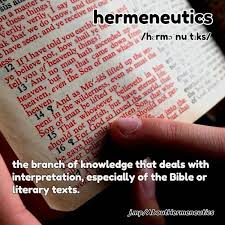
The Definition of Hermeneutics
During a recent fallout over a church split and the
subsequent ousting of the senior pastor, the church community was up in arms
over the influence of Calvinism. The senior pastor was accused of abandoning
the faith (Oneness). An elder in making the case against him cited ‘Sola
Scriptura’ and began to use the proof-texting method to denounce the pastor’s
actions. A more thorough investigation of the claims revealed a lack of
applying proper hermeneutics, which could have prevented the fallout.
Hermeneutics involves ‘the task of explaining, interpreting, and translating
the Scriptures.”[1]
Outside of the objective text, hermeneutics pulls back the curtain, and reveals
the original meaning and context of the author’s work. It is a discipline that
illuminates precisely the intended meaning, whether a single meaning, a fuller,
or even a hidden meaning. Exactly what was the writer trying to communicate to
his audience? It is not enough to just say “The Bible says so.” Nor should
doctrine be made from a position of silence. Hermeneutics then, “provides the
means for understanding the Scriptures and for applying that meaning
responsibly.”[2]Thursday, March 21, 2019
Subscribe to:
Posts (Atom)